Siobhan – Third Update

It’s been a while since we started this project and I haven’t even noticed the time passing by. I changed my diet a bit or made some changes in certain ways, but I didn’t make any drastic changes since I was already a vegetarian and didn’t have to cut out meat. I actually found it relatively easy to cut out dairy and nuts because I found some other alternatives and recognized the health benefits of me lowering my consumption of these items. Between the last update and this update I haven’t really found ways to decrease my water consumption through food any further and have basically continued to eat the same. I still eat mostly all my meals at VG’s and have eaten fruits as snacks instead of granola bars, so that helps in a way. Mostly I have been eating apples (water footprint of 1 apple is 25L) and bananas (water footprint of 1 banana is 160L), but I should transition to eating more citrus instead since the water footprint of an orange is only 80L/orange. 

Unfortunately, I think I also managed to increase my water footprint in a way since I ordered a few smoothies from Booster Juice instead of Village Greens. The smoothies at Booster Juice use yogurt in their drinks while VG’s only uses juice and fruit, so by having smoothies at Booster Juice I actually increased my footprint by roughly 300L as opposed to if I hadn’t ordered smoothies there. Two of my really good friends also visited me this weekend and we ate out at Boston Pizza one night. I totally forgot about watching my food consumption and I ordered a delicious cheesy potato pizza and a side of mozzarella sticks. Only after did I realize that that was one of the worst meals I had eaten in a while, both for carb intake and water consumption (since cheese requires a lot of water to produce). I think that in that one meal I consumed about 800L of water through eating cheese alone. That was a mistake on my part and it reminded me that I really have to constantly watch my food intake. I’m sure that if the restaurant had labelled their menu with the amount of water required for each dish I wouldn’t have ordered what I did. 

My goal for this next period will be to continue to decrease my water footprint and I will also need to continue to watch what I eat, because it’s so easy to make mistakes. I’m also looking forward to tonight because Marina and Hannah and I will be cooking real food at Marina’s house. I think it will be so fun to finally be able to cook my own meals again and I will be happy to not eat cafeteria food for a night. Since we are all doing this eco action project together then we will also make a water-conserving meal. 

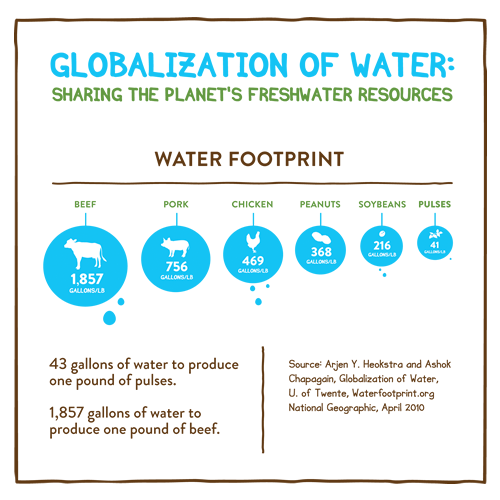
Product Gallery [Water Footprint Network]. (2017). Retrieved from http://www.project-platforms.com/files/productgallery-new.php
Hannah- Third Update

It’s hard to believe that it’s been over a month since we started doing this EcoAction project. At the beginning it felt like my food habits were so ingrained that it didn’t even make sense to try to analyze them and subsequently change them. But it turned out that the hardest parts were researching and calculating the water footprint of my diet; once I’d make the decision to cut out the most water-intensive foods I ate, it was actually pretty simple to adjust.

I’ve started to look more closely at how the “meat substitutes” (as I’ve termed them in my head) that I’m eating compare to each other. To my surprise, when I researched it I found that chickpeas take a lot more water to produce (608.6 gallons per 8 oz) than soy (174.7 gallons per 8 oz), and both of those actually take more water to produce than eggs (93.8 gallons per 8 oz) (Kim, Schleuss, & Krishnakumar, 2015). Although in my baseline week I ate way more eggs than chickpeas or soy, making it the right choice to cut out of my diet, it was still interesting to see the comparison. In the future I will try to move away from eating chickpeas and eat starches that have a lower water footprint instead, such as sweet potatoes, yams, and squash.

Throughout this project I’ve become exponentially more aware of what me and other people around me are eating. Although I feel that my friends and I are mindful about our food choices, it seems to be in a very narrow sense; we don’t put thought toward what we eat beyond whether it’s healthy/tasty/cheap- essentially, beyond any personal impact our food choices have. I think that partly stems from being in such a privileged situation where everything being so easily accessible makes it seem like it took the same amount of work or resources to reach you. I’m glad to have expanded my perspective, and thinking about the entire system connected to the food I eat has made me think about the systems in other aspects of my life as well.

References

Kim, K., Schleuss, J., & Krishnakumar, P. (2015). 351 gallons of water were used to make this plate. Los Angeles Times. Retrieved from http://graphics.latimes.com/food-water-footprint/

Mekonnen, M. M., & Hoekstra, A. Y. (2010). The green, blue and grey water footprint of farm animals and animal products (Main Report No. 48). UNESCO-IHE. Retrieved from https://waterfootprint.org/media/downloads/Report-48-WaterFootprint-AnimalProducts-Vol1_1.pdf

Marina – Third Update

November already! I can’t believe that it’s been over a month since we began our project. I’ve been finding the past couple of weeks fairly easy to stick to the majority of my diet changes on a day to day basis. Since I eat and make most of my meals at home, it’s been easy to omit products like cheese, nuts, yogurt and chocolate from my grocery list and that has effectively removed them from my diet. Given this, I’d like to make the following additional changes for these last few weeks of the project:

  1. Choose tea over my morning coffee 4 times a week
    1. This would decrease my coffee consumption by >50%
    2.  Tea requires on average 13.5 liters of water per 125 ml, whereas coffee requires 132 liters of water for the same sized cup (Chapagain and Hoekstra, 2003)
  2. Use potatoes instead of wheat pasta to bulk out salads (I often make a salad of veggies, beans and pasta for school lunches)
    1. I would estimate that this would decrease my wheat consumption by at least 25%
    2.  Pasta requires 1850 liters/ kilogram, more than 6 times the 290 liters required to produce one kilogram of potatoes (Mekonnen and Hoekstra, 2011)

With these changes in mind, my goal for the next two weeks is to learn some new water-footprint friendly recipes and to stick to the restrictions I’ve set in place for myself, even when eating out. Thankfully Victoria is full of vegan options so it’s not too hard to find something that is relatively water-friendly. On my bucket list of places to try is the Very Good Butchers, a vegan “butcher shop” that serves burgers and comfort food and has many pulse-based meat alternatives for sale. I’m hoping to go in before the end of the project to see what alternatives they offer and how those ingredients compare to their meat counterparts in terms of water use!

Chapagain, A.K. and Hoekstra, A.Y. (2003) The water needed to have the Dutch drink coffee, Value of Water Research Report Series No.14, UNESCO-IHE, Delft, the Netherlands.

Mekonnen, M.M. and Hoekstra, A.Y. (2011) The green, blue and grey water footprint of crops and derived crop products, Hydrology and Earth System Sciences, 15(5): 1577-1600.

Eco Action Update #2 Olivea Griffiths

The goal of this project is to decrease the amount of water that we consume though various types of food products. This process has really opened my eyes to the amount of water consumption even the smallest items produce.

In my first update I had completed my detailed food table explaining the top four foods that I consume that have the largest food footprint. (I wasn’t sure what I should include as my fifth food item) Since then I have been working on removing those items from my diet. This has been quite difficult for me but I have been able to remove just about all meat from my meals! I no longer eat bacon which has saved 816L of water. I have replaced my tea with water which has saved 450L of water. For many of my dinners that I would usually have meat with I have been able to do without and I will often substitute with more veggies like cucumbers. I have also found that a salad with strawberries, spinach and cucumbers is a great snack that have a relatively small footprint. As I mentioned before I was unsure which food I should add as my 5th food. I have decided on cutting out peanut butter. Peanuts consume about 4.7 gallons of water per oz. This will include mt cliff bars and peanut butter which is a very large part of my diet. I will need to be creative and see what type of food I could use to substitute. 

The next step for me will be to officially remove or replace all of the the five food items that I decided on. I am on the right track but I could use a little work and self control! I am looking forward to see how much water in total that I can save.

Nakagawa, T. (2014). Foods With the Lowest Water Footprint. Retrieved from http://www.castagra.com/2014/03/foods-with-the-lowest-water-footprint/

Interactie], F. [. (Ed.). (2017). Product gallery. Retrieved from http://waterfootprint.org/en/resources/interactive-tools/product-gallery/

Pragwater, /. (2016, December 10). Water-footprint. Retrieved from https://pragwater.com/2016/12/09/water-footprint-of-various-foods/water-footprint/

Siobhan – Second Update

Globally, 70% of water consumption is used for agricultural purposes. That is an extremely disproportionate ratio, since it only leaves 30% for other human uses, such as in industry, for direct consumption, or household utilities. Knowing that nearly three quarters of human water usage goes towards agriculture, it is important to focus on this aspect of our lives. By cutting out foods that require a lot of water to produce from our diets then we can help save water. 

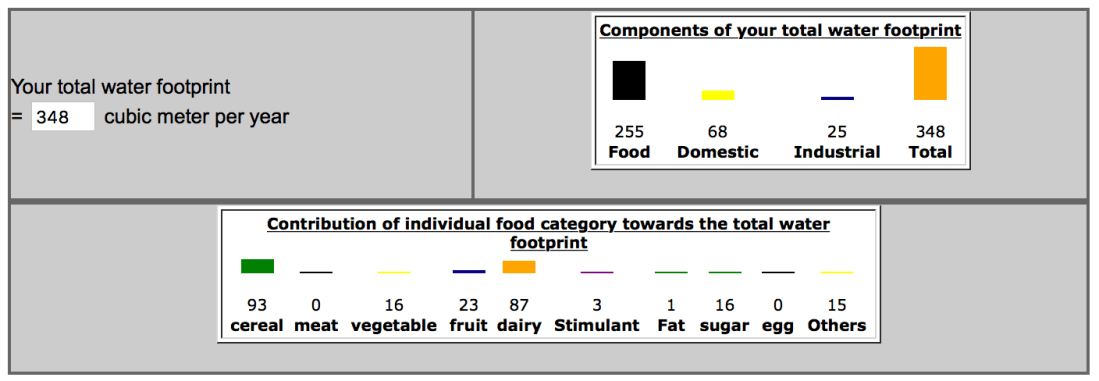
After my first report I have continued to change my diet in order to further reduce my water footprint. Food categories that originally contributed the most to my water footprint were “cereal,” or grains, and dairy (below).

Screen Shot 2018-10-09 at 12.45.04 PM

I already addressed dairy so this time I focused more on my wheat intake, as well as further reducing my nut consumption. After finishing my homemade granola bars I stopped eating nuts altogether, but found that I still really missed my almond butter. While I was at Village Green’s smoothie bar one day I noticed a sign on the counter advertising that Wowbutter, a soy alternative, would be replacing nut butter in the smoothies. I went to the store and picked some up. For a week now I have been using it as a replacement where I used almond butter before, and it’s actually quite good. Soy uses way less water than almonds, since one kilogram of almonds requires 16,095L while one kilogram of soybeans requires 2,145 L. Although this is still a high amount, it is significantly better than eating almonds. To reduce my wheat consumption, I stopped eating crackers as a snack food with hummus, replacing them with vegetables, such as bell peppers and carrots. Wheat has an average water footprint of 1, 827 L/Kg, so by eating peppers and carrots I reduced my water footprint by about 1,487L! I have also continued to try and adapt my meals in the cafeteria. While ordering the vegetable quinoa burger at Cap’s Bistro and the Grill in Cadboro Commons I asked for no bun. This is healthier for me as well as the planet since I’m simultaneously reducing my carb intake and my water footprint by 72 litres (since each bun is around 36 L). 

I also love cooking and am already super tired of cafeteria food, so while I was home over the Thanksgiving long weekend I did a lot of cooking. I paid specific attention to making meals that used less water-dependent ingredients. I think the best example of a meal I made was a vegan cauliflower alfredo dish with zuchinni noodles instead of pasta. It may sound disgusting, but it actually tasted pretty good. The “alfredo” sauce was basically a blend of boiled cauliflower, soy milk, nutritional yeast, garlic, and different seasonings. By using plant-based products I saved a significant amount of water compared to if I had made traditional alfredo sauce, which is made with cream and cheese, both of which are products with very high water requirements. The recipe also originally called for almond milk, but since I am trying to avoid almonds I used soy milk instead. Since I used zuchinni noodles as a healthier alternative to pasta, I also saved a large amount of water. As a result of my adaptations, a dish that normally would’ve been tallied at 5,967 L/Kg has been reduced to 4,401 L/Kg. Although it may not seem like a significantly large change, every small amount still helps the planet, which is what we are trying to prove with our Eco Action Project. 

References: 

Food’s Big Water Footprint. (2018, October 10). Retrieved from https://www.watercalculator.org/water-use/water-in-your-food/foods-big-water-footprint/

Product Gallery [Water Footprint Network]. (2017). Retrieved from http://www.project-platforms.com/files/productgallery-new.php

Water Footprint [Water Footprint]. (n.d.). Retrieved from https://evgenii.com/water-footprint/en/  

Aaidan – Second Update

These past few weeks have been going along fairly smoothly. However, there is one factor that has been giving me trouble, this being, going out. Going out downtown either for studying, shopping or simply hanging out has been a major pain, due to my dietary restrictions now. There have been many incidents where I’ve had to stop myself from ordering food from certain places such as Hillside Coffee & Tea, Dairy Queen, Little Caesars, and Bibliocafé. What all these places have in common is the excessive amount of water their products take to produce. At these moments I’ve had to explain to friends why I can’t order from these restaurants and why I would have to find a different place to find a meal, whether this be at another restaurant or at home.

A way that I have found that is best for combatting this issue is bringing leftovers from home with me whenever I go out such as salad, stir fry, salmon and veggies. This method doesn’t always workout for me, because I might end up staying out for longer than planned. When it comes down to this I know of a couple places I can go that are able to supply me with the foods I require, these places being Green Cuisine in Market Square, and Be Love. Both restaurants only serve vegan meal options and have a wide variety of options that provide all the necessary nutrients and while also having significantly lower water footprints than other restaurants.


Hannah- Second Update

As we go further and further into this project, I’ve learned a lot about how much water it takes to produce food and why it makes such a huge difference in conservation efforts. And the urgency of this project becomes even more clear as I do more research about how increasing pressure is being put on our limited renewable supply of freshwater, and how our global water footprint has exceed sustainable levels in some places already,

It’s still been hard to conceptualize the impact my food choices have. I’ve found that by cutting chicken, eggs, yogurt, nuts, and chocolate out of my diet, I’ve reduced my food water footprint by 4,566 liters per week, although that doesn’t take into account the water footprint of the foods I’ve replaced those ones with. However, that is a huge number (almost too hard to wrap my head around), and it’s easy to realize that it makes an enormous difference over a month or a year or a lifetime.

Knowing quantitatively how much less water I’m using through this project has been a huge motivator to continue doing it. Although it was difficult to adjust my food habits at first, as the project goes on it has become much easier to adapt to not eating the foods mentioned above. The biggest change I’ve made to stick to my project plan is that I now almost exclusively eat at VG’s and get food from the cafeteria salad bar.

I also recently found a helpful interactive tool produced by the LA Times  (http://graphics.latimes.com/food-water-footprint/) and having been using it to explore how much water it takes to produce the rest of the foods in my diet.

Here are some of the resources I’ve used to measure my water footprint:

(Image source: www.healthwaysblog.com)

(Image source: www.latimes.com)

References

Mekonnen, M. M., & Hoekstra, A. Y. (2010). The green, blue and grey water footprint of farm animals and animal products (Main Report No. 48). UNESCO-IHE. Retrieved from https://waterfootprint.org/media/downloads/Report-48-WaterFootprint-AnimalProducts-Vol1_1.pdf

Marina – Second Update

One of the things that I have found most difficult since the beginning of the project has been finding adequate protein sources to replace nuts and cheese, two foods that were common in my diet before. Thankfully, pulses can be used as replacements in many ways so that is the focus of my update this week!

Why replace nuts and cheese?

Cheese requires a large amount of cow’s milk to produce; the ratio of milk needed to produce the same amount of cheese, measured according to weight, is approximately 10:1. This results in a very large water footprint as milk already uses 940 liter/kg, so once processed into cheese the water footprint is a huge 5060 liter/kilogram (Mekonnen and Hoekstra, 2010).

Similarly, nuts are huge consumers of water, with an average footprint of 3970 liter/kg (Mekonnen and Hoekstra, 2010). Commercial almond and walnut farming in particular has been the subject of much criticisism for its contribution to the California drought and the deleption of groundwater in the area (The New York Times, 2015).

The Water Footprint of Pulse Production

(Image source: pulses.org)

Why are pulses a better source of protein?

Pulses are one of the most water efficient sources of protein, requiring only 19 liters per gram of protein. This is a fraction of that required by many other protein rich foods: nuts, for example, require on average 139 liters per gram of protein (Mekonnen and Hoekstra, 2010). Additionally, legume crops are very sustainable in that they are biological nitrogen fixers (Hossain, 2016) which enrich soil quality, decreasing the need for inputs such as nitrogen-rich fertilizer.

How can I use pulses to replace nuts and cheese?

Supplementing your diet with pulses becomes easier once you gain familiarity with them. I’ve been using them to replace meat since I transitioned to vegetarian 6 years ago and a large part of learning how to substitute comes from experimentation! A great resource for those starting out is the visual guide to pulses from pulses.org.

One of my go-to pulse-based foods is hummus, which can be used as a substitute for cream cheese on crackers, sandwiches and savoury bagels. All you need to make hummus is a blender, a can of chickpeas, some tahini (sesame paste), lime or lemon juice, and some spices. There is a wealth of hummus recipes online with every flavour combination imaginable, so I encourage you to go forth and experiment! My personal favourite incorporates roasted red peppers, but I made a batch of chipotle and lime hummus earlier this week and it is quite delicious.

Oatmeal is a comforting and warming breakfast, especially for the chilly mornings we are getting now that it is mid-October. I used to bulk out my oatmeal with fruit and almonds, but a great protein-rich alternative is this red lentil power porridge (omit the almond butter topping).

When I am short on time one of my go-to weeknight meals is pasta with lentils. This is more of a meat replacement than anything else, but I find that sauce with lentils in it is filling and flavourful enough to be enjoyed on its own without being covered in parmesan. On those days when I get home late and super hungry I often sautee some vegetables in a pot, throw in a can of drained lentils and a jar of marinara, and combine it with whatever pasta I have on hand. It makes great leftovers as well!

Citations:

Buchanan, L., Keller, J., & Park, H. (2015, May 21). Your contribution to the california drought. The New York Times. Retrieved from https://www.nytimes.com/interactive/2015/05/21/us/your-contribution-to-the-california-drought.html, https://www.nytimes.com/interactive/2015/05/21/us/your-contribution-to-the-california-drought.html
Hossain, Z. (2016). Biological nitrogen fixation by pulse crops on the semiarid Canadian Prairie. Canadian Journal of Plant Science. Retrieved from http://www.bioone.org.ezproxy.library.uvic.ca/doi/pdf/10.1139/cjps-2016-0185
Mekonnen, M. M., & Hoekstra, A. Y. (2010). The green, blue and grey water footprint of farm animals and animal products (Main Report No. 48). UNESCO-IHE. Retrieved from https://waterfootprint.org/media/downloads/Report-48-WaterFootprint-AnimalProducts-Vol1_1.pdf


Aaidan – First Update

Our groups purpose was to reduce our overall food footprint by reducing/eliminating foods we regularly consume that require the most water to produce. For me this has not been going over too well. In week one of the project I wrote down all the dishes and snacks I ate and what food products were used to make them. With the help of the “Water Footprint Networks” Product gallery page (has the average amount of water that goes into producing certain food products), I was able to detect which foods I have been eating that use the most water to produce, these foods being: firstly, ground beef (uses 15400 Litre/Kg); secondly, cashews (uses 2780 Litre/Kg; thirdly, Pasta (1827 Litre/Kilogram); fourthly, Eggs (1 egg = 200 litres); lastly, cheese (940 Litre/Kg).

Once I had identified my top five foods, I had to figure out how I would decrease my consumption of these by substituting them with other products, or just lowering my consumption. I first cut down my cheese consumption, I did this by removing the cheese I put in my scrambled eggs, and in my sandwiches. This went over fairly easy but there are some times when I do take a slice or two off the block as a snack. By removing my famous pasta dish out of my diet I have completely removed pasta, ground beef, sausages and partly cheese out of my diet. This basically has removed most of my major water footprint.

On thanksgiving weekend however, I was a bit naughty. My family cooked two chickens a truckload of vegetables and some bread. Sure chicken has a smaller water footprint than beef but that doesn’t mean it takes a little water to produce a chicken. The amount of water that went into producing these foods was excessively high. To fix this problem so that it doesn’t happen again, I’ll look into alternative food options (Mainly vegetable dishes) that use up less water the next time my parents come into town.


Siobhan – First Update

When talking about our water footprint we may think of how much water we use to shower or wash a load of laundry, and perhaps not so much about how much water is required to produce the foods we eat. In fact, we use more water through food consumption than through direct use! This fact really surprised me and I became curious on how to reduce my water consumption and create a more eco-friendly food footprint through this change. I originally thought that I would have a small food footprint and wouldn’t be using a lot of water in my diet since I am a vegetarian; however, I quickly learned that although meat requires the most amount of water to produce, it isn’t the only food product with a high water consumption level. Foods like almonds and other animal products, like dairy or eggs also use a lot of water. 

After establishing a baseline and researching specific water usage for certain foods, I  discovered that several of my foods of choice, such as nuts, yogurt, and cheese, required a lot of water to produce. My water consumption also really surprised me. Apparently in one week I used approximately 15, 836L of water by simply eating food! I then realized that I had to change my eating habits and alter my diet to account for water usage. Although chocolate milk, Nutella, and chocolate bars are tasty, they’re not the healthiest things to consume and they negatively affect the planet. Knowing this, it was easier to cut these treats out of my diet completely. It was harder, and more intimidating, to remove almonds, greek yogurt, and even cheese from my diet, since I eat these foods almost everyday and they’re an important and necessary source of protein for me. Knowing I wouldn’t be able to fully cut out yogurt from my diet, I decided to settle for a better, more eco-friendly alternative: regular yogurt rather than greek yogurt. By making this switch, and by decreasing my weekly yogurt consumption from daily/every second day to only 3 times a week, I have cut down my water footprint by approximately 1, 270 L /week. I also significantly cut down cheese consumption, which is healthier for me too due to cheese’s high fat content. I haven’t bought any more cheese from the grocery store since finishing off the last block. It’s also been easy to adapt my meals in Cap’s Bistro to be more water-friendly. I began exchanging cheese slices for extra veggies at the sandwich bar, and I stopped ordering olives as well, since they’re one of the fruits that requires a large amount of water to produce (3015L/kg). This change has further reduced my water consumption by approximately 300L. 

Perhaps one of the most significant alterations to my diet, and subsequently my food footprint, has been my removal of almonds and almond butter from my diet. Before, during the baseline week, I consumed approximately 140g of almonds and 28 servings of almond butter (I know, it’s a lot), which resulted in me using roughly 4,381L. This is a shocking amount, and while I have cut out almonds, I have found it challenging to quit eating other types of nuts altogether. I have continued eating walnuts and hazelnuts since they’re ingredients in my favourite homemade granola bars. These nuts are better alternatives since they require less water to produce than almonds (2532.44L less), but they’re still not the best alternative because of their higher than average water footprint. After I finish eating my granola bars I will stop eating nuts for the remainder of the term and see what difference that makes with my food footprint. 


References:

Mekonnen, M., Hoekstra, A., & Chapagain, A. (2005). Personal calculator – extended. Retrieved from http://waterfootprint.org/en/resources/interactive-tools/personal-water-footprint-calculator/personal-calculator-extended/

Lurie, J. (2017, June 24). It takes HOW much water to make Greek yogurt?! Retrieved from https://www.motherjones.com/environment/2014/03/california-water-suck/

Kim, K., Schleuss, J., & Krishnakumar, P. (n.d.). Eating the drought: How much water goes into your meal? Retrieved from http://graphics.latimes.com/food-water-footprint/

Food’s Big Water Footprint. (2018, October 10). Retrieved from https://www.watercalculator.org/water-use/water-in-your-food/foods-big-water-footprint/