Globally, 70% of water consumption is used for agricultural purposes. That is an extremely disproportionate ratio, since it only leaves 30% for other human uses, such as in industry, for direct consumption, or household utilities. Knowing that nearly three quarters of human water usage goes towards agriculture, it is important to focus on this aspect of our lives. By cutting out foods that require a lot of water to produce from our diets then we can help save water.
After my first report I have continued to change my diet in order to further reduce my water footprint. Food categories that originally contributed the most to my water footprint were “cereal,” or grains, and dairy (below).
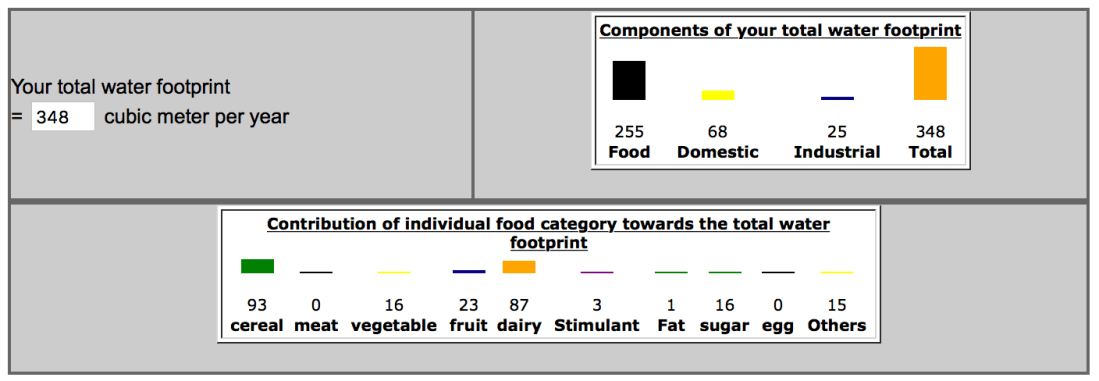
I already addressed dairy so this time I focused more on my wheat intake, as well as further reducing my nut consumption. After finishing my homemade granola bars I stopped eating nuts altogether, but found that I still really missed my almond butter. While I was at Village Green’s smoothie bar one day I noticed a sign on the counter advertising that Wowbutter, a soy alternative, would be replacing nut butter in the smoothies. I went to the store and picked some up. For a week now I have been using it as a replacement where I used almond butter before, and it’s actually quite good. Soy uses way less water than almonds, since one kilogram of almonds requires 16,095L while one kilogram of soybeans requires 2,145 L. Although this is still a high amount, it is significantly better than eating almonds. To reduce my wheat consumption, I stopped eating crackers as a snack food with hummus, replacing them with vegetables, such as bell peppers and carrots. Wheat has an average water footprint of 1, 827 L/Kg, so by eating peppers and carrots I reduced my water footprint by about 1,487L! I have also continued to try and adapt my meals in the cafeteria. While ordering the vegetable quinoa burger at Cap’s Bistro and the Grill in Cadboro Commons I asked for no bun. This is healthier for me as well as the planet since I’m simultaneously reducing my carb intake and my water footprint by 72 litres (since each bun is around 36 L).
I also love cooking and am already super tired of cafeteria food, so while I was home over the Thanksgiving long weekend I did a lot of cooking. I paid specific attention to making meals that used less water-dependent ingredients. I think the best example of a meal I made was a vegan cauliflower alfredo dish with zuchinni noodles instead of pasta. It may sound disgusting, but it actually tasted pretty good. The “alfredo” sauce was basically a blend of boiled cauliflower, soy milk, nutritional yeast, garlic, and different seasonings. By using plant-based products I saved a significant amount of water compared to if I had made traditional alfredo sauce, which is made with cream and cheese, both of which are products with very high water requirements. The recipe also originally called for almond milk, but since I am trying to avoid almonds I used soy milk instead. Since I used zuchinni noodles as a healthier alternative to pasta, I also saved a large amount of water. As a result of my adaptations, a dish that normally would’ve been tallied at 5,967 L/Kg has been reduced to 4,401 L/Kg. Although it may not seem like a significantly large change, every small amount still helps the planet, which is what we are trying to prove with our Eco Action Project.
References:
Food’s Big Water Footprint. (2018, October 10). Retrieved from https://www.watercalculator.org/water-use/water-in-your-food/foods-big-water-footprint/
Product Gallery [Water Footprint Network]. (2017). Retrieved from http://www.project-platforms.com/files/productgallery-new.php
Water Footprint [Water Footprint]. (n.d.). Retrieved from https://evgenii.com/water-footprint/en/

 Reducing Our Food's Water Footprint